




Congenital squint
Sometimes a baby is born with a squint, although it may not be obvious for a few weeks. In about half of such cases, there is a family history of squint or the need for spectacles. The muscles are usually at fault.
Long sight (hypermetropia)
This can sometimes lead to a squint developing as the eyes are over-focusing whilst trying to see clearly.
The over-focusing produces double vision. In an attempt to avoid this, the child may automatically respond by suppressing the image from one eye and turning it to avoid using it. If left untreated, a "lazy eye" may result. The most common age for this type of squint to start is between 10 months and 2 years, but it can occur up to the age of 5 years. It is usually first noticed when a baby is looking at a toy, or at a later age when a child is concentrating on close work, such as a jigsaw or reading.
Childhood illnesses
Following an illness such as measles or chickenpox, a squint may develop. This may mean that a tendency to squint has been present but, prior to the illness, the child was able to keep his or her eye straight.
Nerve damage
In some cases a difficult delivery of a baby or illness damaging a nerve can lead to a squint.
Can a baby have a squint?
Yes, a baby can have a squint, especially if there is a family history. If this is suspected, it is important that the baby be referred for accurate assessment at the earliest opportunity. Sometimes a baby has what is known as "pseudo squint" which is related to the shape of the face, but a baby with a true squint will NOT grow out of it.
Isn't a squint just a cosmetic problem?
Certainly the appearance can lead to problems for the child, but a squint is not merely a cosmetic problem. If left untreated, it can lead to a permanent visual defect in the squinting eye.
How can you tell if a child has a squint?
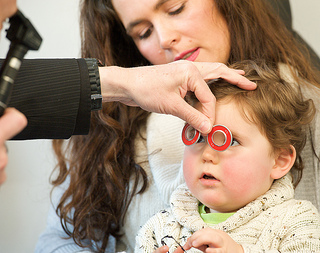
People often think that they can tell if a child has a squint if their eyes look different. This is not necessarily a squint. Squints are often difficult to detect, especially in younger children. Older children may complain of sight difficulties such as double vision. If it is thought that a child has a squint, the Health Visitor, Child Health Clinic, GP or school doctor / nurse should be asked about a referral to an optometrist, ophthalmic medical practitioner or hospital eye clinic for assessment.
Free NHS Eye Examination only available at our Newcastle Practice Tel. 0191 232 1002


What is a squint and how common is it?
A squint (also known as a strabismus) is a condition which arises because of an incorrect balance of the muscles that move the eye, faulty nerve signals to the muscles and some refractive error (focusing faults). If these are out of balance, the eye may turn in (converge), turn out (diverge) or sometimes turn up. Approximately 5% to 8% of children are affected by a squint or a squint related condition, which means 1 or 2 in every group of 30 children. If a child appears to have a squint at any age from six weeks onwards, it is important to seek professional advice quickly. Many children with squints have poor vision in the affected eye.
What causes it?
There are several types of squint. The cause is not always known, but some children are more likely to develop it than others.
Squint
Squint can be a complex condition and not every situation is covered here, but your optometrists will be pleased to give further advice, if needed. Children will benefit from support and encouragement during treatment, therefore, people should not be afraid to ask questions which will help them understand the condition and treatment. The successful outcome of treatment depends upon everyone co-operating.


What treatment is available and will an operation always be needed?
No. An operation is not always needed. Treatment varies accordingly to the type of squint. The main forms of treatment are:
Spectacles: To correct any sight problems,
especially long sight.
Occlusion: This is patching the good eye to encourage the
weaker eye to be used. This is done under orthoptic supervision.
Eye drops: Certain types of squint can be treated with the
use of special eye drops.
Surgery: This is used with congenital squints, together with other
forms of treatment in older children, if needed, Surgery can be
performed as early as a few months of age.
College of Optometrists - Look after your eyes website