




THE RIGHT FRAME
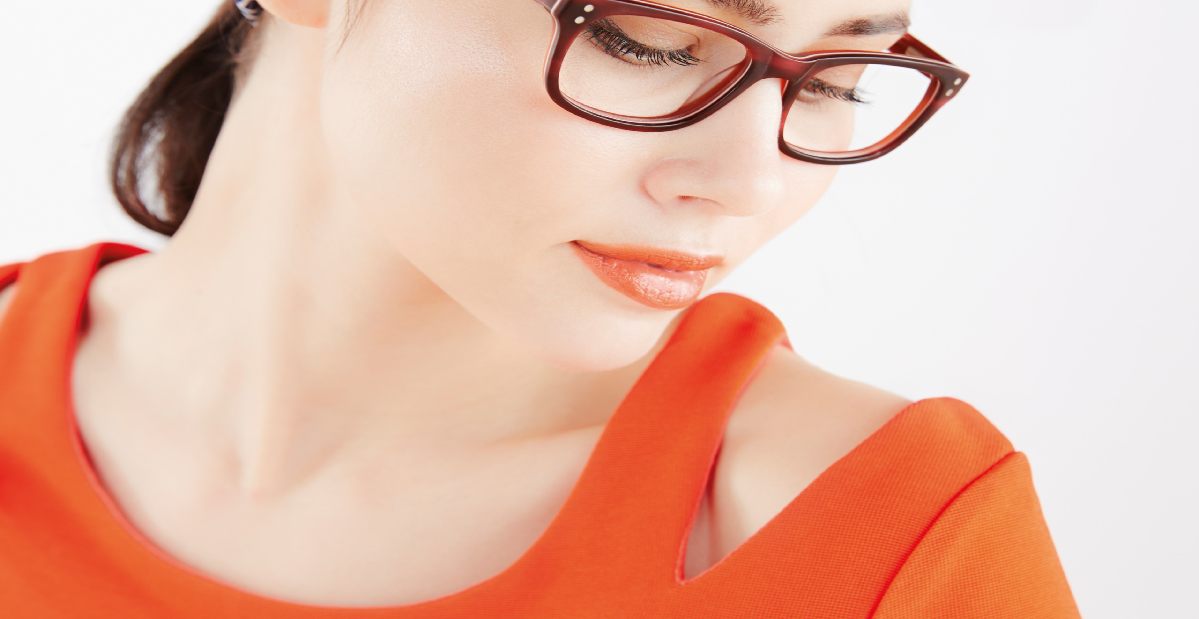
There is a fantastic choice of frame styles and colours to choose from. But how do you make sure you pick the
right ones for your complexion?
We are here to help you of course, but you may want to consider the following few tips to help you look and feel
great:
Pale Complexions
Lightweight metal frames, or those with a hint of colour such as rose or amber, can look good. Clear crystal
frames are too colourless for most pale complexions, but tortoiseshell can often work well.
Dark Complexions
People with olive, Mediterranean, golden or Asian skin and rich black hair often look best in silver, gold or clear
frames. Black frames can be too heavy even if they are quite trendy.
Black Skin
All metallic frames suit black skins. Amber usually works well too. Other colours are worth trying but black may be
too heavy.
Whatever you choose, couple the frames with plastic or glass lenses, and an anti-reflective coating, and you will
have a pair of glasses that are functional as they are good looking.
What type of lenses are available to fill prescriptions?
The simplest form of spectacle or contact lens is the single vision lens, be it concave or convex. This means that
the lens is made to a single prescription to correct a particular vision deficiency, be it short or long-sightedness.
The following documents contain information on various spectacle lenses
A convex lens has either one or both of its surfaces curving outwards, that is, wider divergence from the plan at
the centre. Theses lenses are used to correct long-sightedness (hypermetropia). The more long sighted a person
is, the more convex the lens has to be to correct the vision deficiency by bringing the rays of light into focus.
A long sighted person's focus is actually some way behind the back of the eye and the convex lens pulls the rays
of light together sooner than they normally would be.
A concave lens is the opposite of a convex lens. Here one or both of the lenses surfaces are curved inwards. That
is, the centre of the lens is closer to the plane than the edge. A concave lens is used to correct short-sightedness
(myopia). A short sighted person's focus is focusing before the back of the eyeball. The concave lens pushes the
rays of light further apart so that they arrive together in proper focus at the back of the eye.
These are lenses which react to light, so that in dull conditions they have a soft neutral tint, and in bright light react
with a tint appropriate to the strength of that light. Unlike glass, the latest plastic photochromic lenses give
maximum protection against harmful ultra violet light and are especially useful against harsh glare or fluorescent
lights and VDU screens. These lenses can be supplied in glass or lightweight plastic to suit most prescriptions.
The bifocal lens is seen frequently, if decreasingly. It contains two optical corrections. The most common use of a
bifocal is for people who have become presbyopic, as we all do with age, and need assistance with both close
work and long distance vision. The upper part of the lens is used to correct the shortsightedness, whilst the lower
half assists with reading or other close work. Between the two parts, there is a distinctive line.
Trifocals
These can be distinguished from bifocals by the fact that they have three sections, incorporating a correction
for middle distance sight. They can be seen visually by the fact that they have two lines separating the different
parts of the lens. Some people find these useful once they have been able to adjust to the lines on the lens, but
many find them distracting. Few of these lenses are prescribed today.
The varifocal or progressive lens is the modern day equivalent of the bi and trifocal lenses. These lenses have
no distracting lines between the different prescription areas, but have a graduated section that moves smoothly
from one prescription to the other. These are the lenses of the future and are much more heavily used in many
countries already. They provide the dual benefit of being better cosmetically; they do not draw attention to the
ageing process, that Presbyopic is in all of us, and don't have the distracting lines across the lens for the wearer.
Spectacle lenses these days can be provided with reflection-free coatings which virtually eliminate distracting
reflections - from lights or windows for example - on the back or the front of the lens, helping people to see
better and to be visually more satisfying. A very fashionable and expensive spectacle frame can be ruined by
the glare coming back from reflections on people's lenses.
Scratch resistant / hardening coating
People tend not to have the time to treat their spectacles as well as they might. Beyond that there are every
day accidents. Scratched lenses can at lest be an irritant to the wearer and look unsightly, and at worst
become impossible to use. However, lenses can now be dispensed with a scratch resistant coating, which
prolongs their lives.